

Starting with the quint()
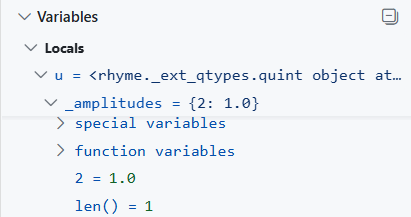
We start with just one value using quint():
u contains the value 2 with amplitude 1, which is the starting value of our Fibonacci series.
The debugger shows:
Finding Fibonacci numbers
First, we need two small Python functions to work with Fibonacci numbers and their positions.fib() gives us the Fibonacci number at a given index:
fib_index() does the opposite. It gives us the index of a Fibonacci value:
Pairing Fibonacci values
Now comes the interesting part. We want to pair a Fibonacci numberx with the Fibonacci number whose index is obtained by flipping bit bit_idx of its index.
x:
bit_idx of that index:
x.
For example, when bit_idx = 2, we pair the indices:
pair() is our rule for saying: “This Fibonacci value is paired with that Fibonacci value.”
Building more Fibonacci values
Now we use these pairs withinterfere().
We want to generate the first Fibonacci values. For our example, k = 3, so we want:
interfere() takes the pairs that we want to combine.
The left side of each pair is selected by:
bit_idx equal to 0.
We start with index 0, which has the value:
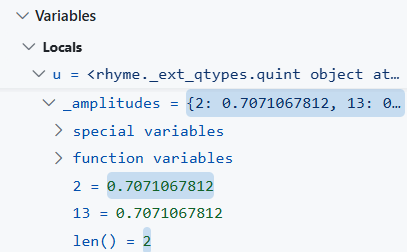
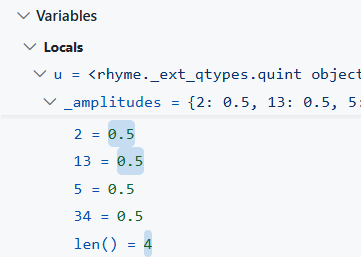
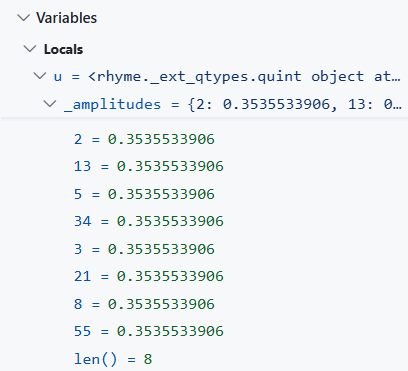
What happened?
We started with the first Fibonacci value,2. Then, for the later values, we: