

2.1 Superposition
In the code snippet below, we can think of the ordinary Python variablei as referring to a segment of memory (e.g. 3 consecutive bits) that holds the value 5:
j holding the values 5 and 6 in superposition:
j as referring to a segment of memory (e.g. 3 consecutive bits) that somehow holds both values 5 and 6 at the same time. More precisely, j holds a value that is a “combination” of 5 and 6. When executed on a quantum computer, the code above physically creates superposition! On your laptop, it simulates superposition.
If you don’t 100% grasp superposition, then join the club: nobody on the planet does. Nevertheless, superposition is an experimental fact. The best we can do is to try to get used to it and see if we can harness it to solve interesting problems.
2.2 Amplitudes
According to quantum mechanics,5 and 6 each “participate” in the superposition with some amplitude. We can see in the debugger that the qint() constructor created a uniform superposition of its arguments 5 and 6, each participating with an amplitude of :
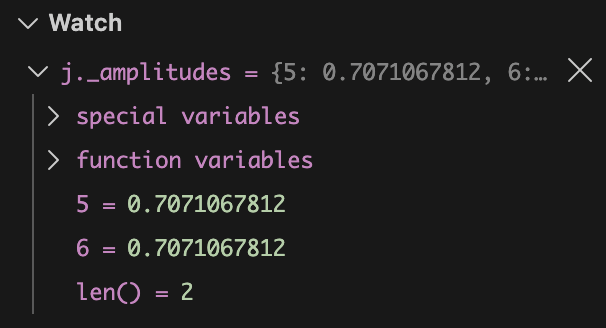
_amplitudes is a private attribute because, in the physical world, the amplitudes in a superposition cannot be directly seen. However, for educational and debugging purposes, Rhyme allows you to “cheat” and view them in the simulator.
An important rule is that, at any point in time, the absolute squares of the amplitudes are guaranteed to add up to 1. The reason for this will become clear later.
2.3 Phase change
In Rhyme, quantum programming is the art of manipulating the amplitudes. According to quantum mechanics, the amplitudes don’t have to be positive numbers. They may be negative, or even complex numbers! Let’s use theadd_phase() method to negate the amplitude of 5:
lambda function specifies that the amplitude of 5 is rotated by 180 degrees (pi radians) in the complex plane, which means negation, while all other amplitudes are rotated by 0 degrees (no change).
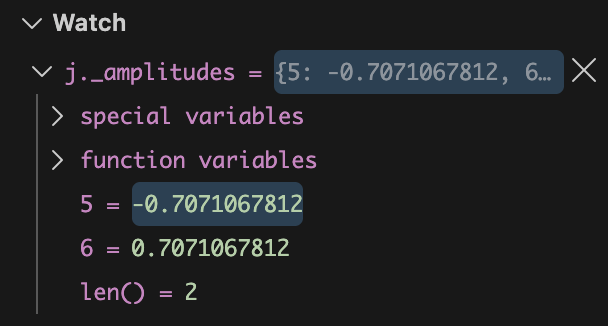
Indeed, the debugger now shows that the amplitude of 5 is :
2.4 Interference
add_phase() does not change the absolute values of the amplitudes. To manipulate the absolute values, we can use the interfere() method:
interfere() mixes the amplitudes pairwise. The first lambda argument forms pairs by mapping values to each other. In this case, 6 and 7 are paired. If a value is mapped to itself, its amplitude won’t change. The second lambda argument determines the “left” element in a pair by returning True for the “left” values. Here, we have (6, 7), not (7, 6), because 6 is the “left” value.
Let a denote the amplitude of 6 (the “left” amplitude) and b the amplitude of 7 (the “right” amplitude). The rule is that a changes to and b to .
But wait a moment… 7 doesn’t even participate in the superposition. How can it have an amplitude? Well, although we say it “doesn’t participate,” formally it is still there with amplitude zero! Thus, the formulas for interfere() can be applied with a = 1/sqrt(2) and b = 0.
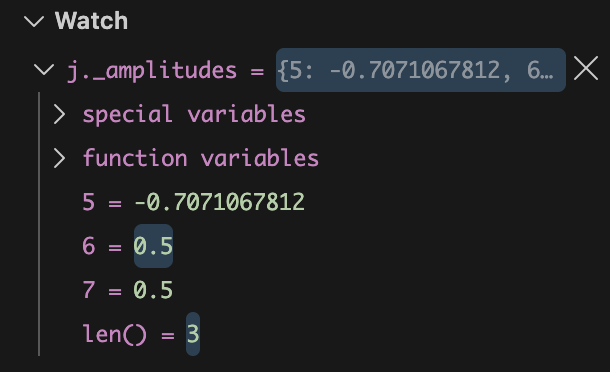
The debugger now shows that the amplitudes of 6 and 7 are both one half, as per the formulas above:
2.5 Observation
Are you curious what a superposition looks like? Let’s observe it!5, and a 25% chance each for 6 or 7.
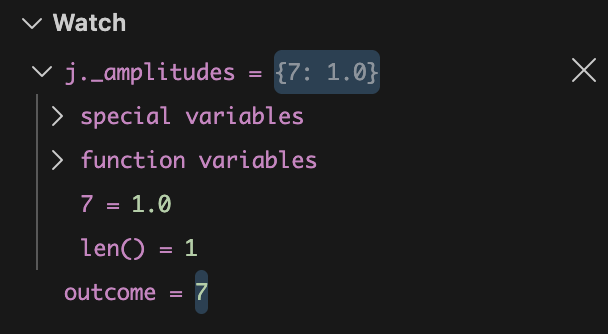
The value of j collapsed to 7, which was also returned in outcome:
2.6 Universality
Using theadd_phase(), interfere(), and observe() methods of a quantum integer, you can compute anything that can be computed on a quantum computer.